
The Shofu Group has established a corporate philosophy of "Contribution to dentistry through innovative business activities" under which we are determined to work to solve social issues through corporate activities in cooperation with stakeholders, aiming to improve corporate value over the medium- to long-term and create a sustainable society. We have established the following policy as an outline of our basic approach to achieving this.
-
Contribute to a higher QOL for people
We strive to accurately identify the needs of society and the market and to deliver safe, reliable, and high-quality products and services. We also ensure the proper provision of product information, dental care information, and other related content, thereby contributing to improving the quality of life for people around the world.
-
Promote corporate activities that are friendly to the global environment
We seek to act in harmony with the global environment and to fulfill our social responsibility toward sustainability. To this end, we are working to reduce greenhouse gas emissions from our business operations, promote waste reduction and reuse, and advance other environmentally responsible initiatives, thereby contributing to the realization of a decarbonized and circular society.
-
Strengthen our management base to support corporate value enhancement
We aim to strengthen our management foundation to support the enhancement of corporate value. To this end, we are committed to conducting our business with integrity and fairness while reinforcing our corporate governance, compliance, and risk management frameworks.
-
Cultivate a rewarding organizational culture and develop human resources
Guided by the belief that people are the source of new value and that the collective contribution of each individual shapes the value of the Company, we respect diversity and provide opportunities for continuous learning and growth. Through these efforts, we aim to cultivate an organizational culture and work environment in which every member of the Shofu Group can fully realize their potential and work with vitality.
In response to climate change, one of our corporate activities that are friendly to the global environment, we are making efforts and disclosing information in line with the TCFD recommendations.
Governance
- In December 2021, the Shofu Group established the Sustainability Committee, chaired by the President and Representative Director and convened in principle twice a year. The Committee was created to advance management practices that incorporate sustainability perspectives, in recognition of the growing importance of addressing social issues to help realize a sustainable society while enhancing medium- to long-term corporate value.
- The Sustainability Committee deliberates on the formulation of basic sustainability policies, strategies, and plans, and sets targets, based on sustainability-related risks and opportunities. It also monitors the status of initiatives, and reports and makes recommendations to the Board of Directors at least once a year, based on which the Board deliberates and gives supervision.
- The Board of Directors holds the responsibility and authority for overseeing risks and opportunities related to sustainability. It receives reports on matters reviewed by the Managing Executive Board and the Sustainability Committee, and based on these reports, it deliberates on and supervises the Shofu Group's policies, action plans, and other measures for addressing sustainability-related risks and opportunities.
- We have also established the Sustainability Committee Secretariat (the "Secretariat"), which is responsible for administering the committee and working with related committees to develop and drive sustainability initiatives. The Secretariat consolidates agenda items for committee meetings, coordinates necessary internal arrangements based on the committee's instructions, and promotes operational-level discussions and implementation of sustainability measures. It reports its activities to the Sustainability Committee and receives further guidance as needed.
- We set goals and action plans, identify priority initiatives, and regularly review progress toward these plans. We also disclose relevant risks, opportunities, and their potential financial impacts to our stakeholders.
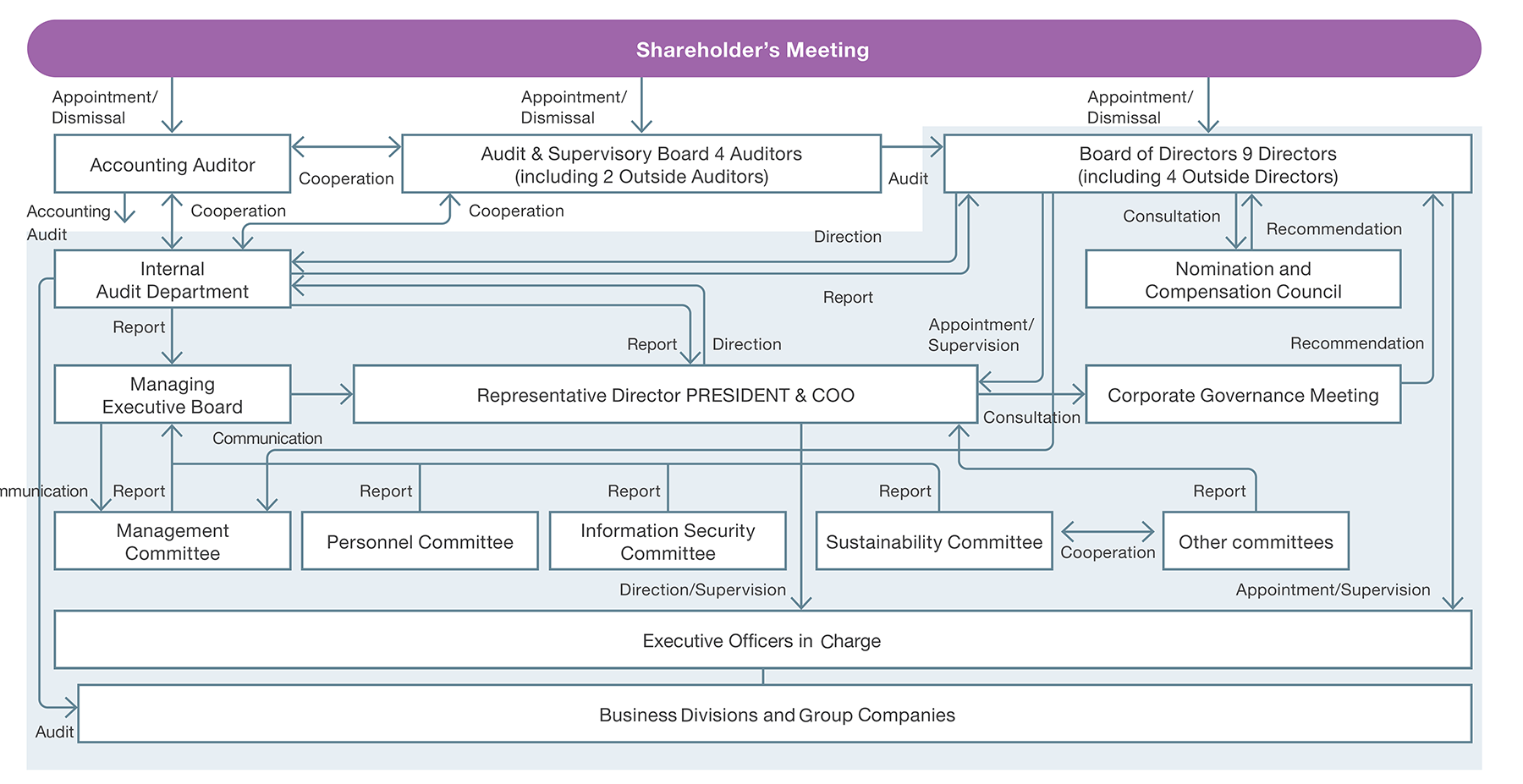
Corporate Governance Structure
Our organizational structure is shown below.
Strategies
Scenario Analysis
- The Shofu Group conducts scenario analyses for 2030 and 2050, assuming global temperature rise pathways of 1.5℃, 2℃, and 4℃ by 2100.
- In the initial year, the analysis covered only the Company and its domestic subsidiaries, and we plan to extend the scope to our overseas subsidiaries in stages.
-
We assess materiality and evaluate potential financial impacts with reference to scenarios published by the government agencies and research institutions listed below.
- IEA 「World Energy Outlook 2022」 NZE2050 / APS / STEPS
- IPCC 「AR6」 SSP1-1.9(1.5℃ Scenario) / SSP1-2.6(2℃ Scenario) / SSP5-8.5(4℃ Scenario)
Risks and Opportunities
| Type | Factors behind risks and opportunities | Details | Financial impact in 2030 | ||
|---|---|---|---|---|---|
| 1.5℃ (2℃) |
4℃ | ||||
| Transition risks |
Policies and regulations |
Progress in pricing GHG emissions Strengthened GHG emissions reporting requirements | Energy, procurement, and transportation (logistics) costs will increase due to introduction of carbon tax. | Medium | - |
| Shift to mandatory status/regulation of existing products and services | Procurement risks and costs will increase due to tightening of environmental laws and regulations. | Small | - | ||
| If plastic regulations are tightened and the shift to plastic alternatives in our products does not progress, then we will be shut out of markets, primarily in Europe. | Medium | - | |||
| Technology | Upfront costs associated with transition to low-carbon technologies | Increased development and capital investment costs to invest in materials and technologies with lower environmental impact | Small | - | |
| Physical risks |
Acute | Increase in the severity and frequency of abnormal weather events such as cyclones and floods Increased likelihood and severity of wildfires | Large-scale natural disasters (typhoons, torrential rains, floods, wildfires, etc.) will cause the Company's operations to stagnate, making it difficult to provide a stable supply of products and leading to a decline in sales. | Medium | Medium |
| Opportunities | Resource efficiency |
Use of efficient means of transportation Use of efficient production and distribution processes | Production, transportation and storage costs can be reduced by using efficient production and distribution processes. | Small | Small |
| Energy costs can be reduced by saving energy. | Small | Small | |||
| Use of recycling | Raw material costs can be reduced by reducing the amount of raw materials required, by recycling product components and packaging materials. | Small | - | ||
| Products and services |
Development of low-carbon products and services, development of new products and services through expanded R&D and innovation | The development of products that contribute to improving the efficiency of dental care and reducing CO2 emissions will increase sales of our related products. | Medium | - | |
| Resilience | Participation in renewable energy programs and adoption of energy-saving measures | Relocating production bases and promoting the distribution of energy procurement sources, including renewable energy, is expected to improve resilience in the event of a disaster or grid power accident (business continuity and suppression of rising energy procurement costs). | Small | - | |
Notes:
- GHG: An abbreviation for greenhouse gases.
- The 4℃ scenario assumes a world where there are no GHG emissions regulations or environmental regulations, so some risks and opportunities are not calculated or evaluated.
Risk Management
- The Group's Sustainability Committee discusses the identification of sustainability-related risks and opportunities, and the narrowing down of risks and opportunities that should be prioritized, and reports to the Board of Directors.
-
Climate change-related risks and opportunities are managed through the following activities 1-5 , and reviewed periodically.
- Scenario analysis for climate change
- Identification of short-, medium-, and long-term climate-related risks and opportunities
- Determination of strategic initiatives and policies to address the important climate-related risks and opportunities that have been identified
- Consideration of actual measures to address climate-related risks and opportunities
- Implementation of measures to address climate-related risk and opportunities and management of progress
- Based on the results of monitoring, we have established a system that enables us to respond flexibly and optimally, according to the degree of impact on business management. Important risks relating to climate change are reported to the Managing Executive Board for coordination with company-wide risks.
Measures
- For the identified risks and opportunities, we will implement medium- to long-term response measures and continually assess their effectiveness to strengthen the resilience of our business operations.
| Measures | Details |
|---|---|
| Using energy to adapt to a decarbonized society |
|
| Balancing contributions to dental care with decarbonization initiatives |
|
| Establishing a stable business base to respond to the growing severity of natural disasters |
|
| Appropriately responding to environmental regulations |
|
Metrics and Targets
- Since FY2021, the Group has been working to track CO2 emissions from its business activities (hereinafter referred to as "Scope 1 and Scope 2").
-
To reduce greenhouse gas emissions, the Group has set the following reduction targets for Scope 1 and 2, using FY2021 Scope 1 and 2 values as the baseline values.
Reduce Scope 1 and 2 emissions by 27% by FY2030 (compared with FY2021)
Achieve carbon neutrality by FY2050 - We will also advance our efforts to quantify CO₂ emissions across the entire supply chain (Scope 3), including emissions from material procurement and the end-of-life treatment of our products. In parallel, we will contribute to reducing these emissions by promoting energy use aligned with a decarbonized society and by pursuing initiatives that support both dental care and decarbonization.
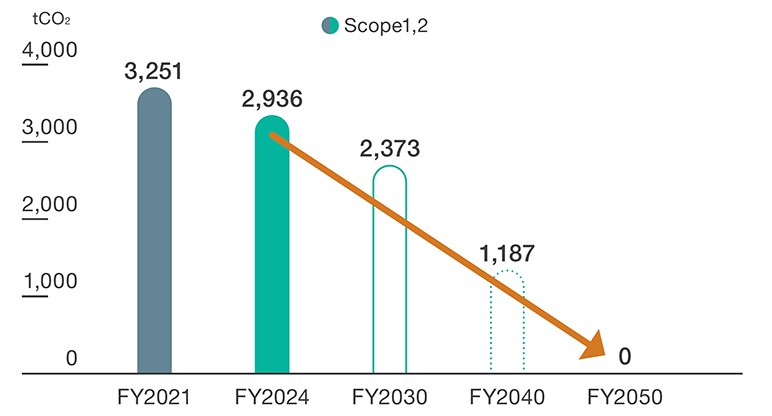
Scope 1 and Scope 2 Emissions: Performance and Reduction Targets
